Choosing a Cordless Drill Kit for Home and Outdoor Projects
Drill/driver vs impact driver, brushless motors, battery platforms and which kit makes sense for deck, fence and around-the-house projects.
As an Amazon Associate I earn from qualifying purchases. Backyard North may earn a commission when you buy through links on this page, at no extra cost to you. How we make money.
If you build, fix or hang anything around the house, the cordless drill kit is the tool you’ll reach for most. It’s also the tool that locks you into a battery platform for years, so it’s worth choosing deliberately.
Drill/driver vs impact driver
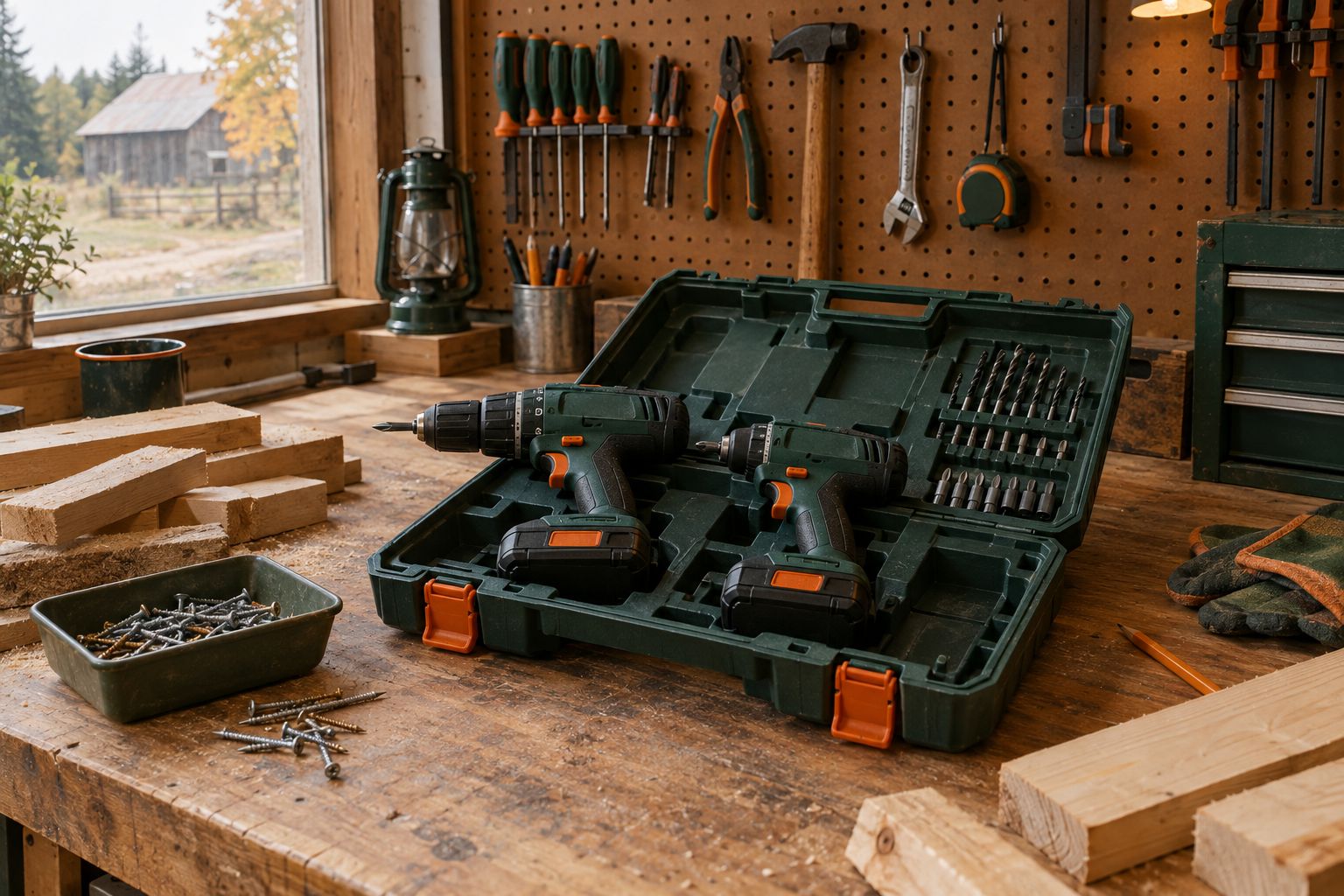
Most “combo kits” include both, and for good reason.
Drill/driver — the all-rounder. Drills holes, drives screws, mixes small batches with a paddle bit. Has an adjustable clutch so you don’t strip screws or sink them too deep in drywall.
Impact driver — built for driving screws and lag bolts fast. It adds rotational “hammering” force, so it sinks 3-inch deck screws without bogging down or twisting your wrist. It uses hex-shank bits and isn’t designed for precise drilling.
If you’re building a deck, fence or shed, an impact driver will save your forearm. For general household tasks, the drill/driver does most of the work.
Key specs in plain language
- Voltage (12V vs 18V/20V). 12V tools are compact and light — great for furniture, cabinets and tight spaces. 18V/20V (same class, different marketing) is the standard for outdoor and construction projects.
- Brushless motor. More efficient, longer runtime and longer life than brushed motors. Worth the extra money if you’ll use the tool regularly.
- Battery capacity (Ah). 2.0 Ah batteries are light; 4.0–5.0 Ah run longer. A kit with one of each is a nice combination.
- Chuck size. 1/2-inch chucks accept larger bits.
- Hammer drill function. Needed if you’ll drill into brick, block or concrete — useful for hanging things on a basement wall.
Pick a battery platform first
The battery is the real investment. Once you have two or three batteries and a charger, every future tool is cheaper as a “bare tool.” Consider which platform also covers things you’ll want later: circular saw, leaf blower, string trimmer, work light, even a snow blower.
Popular platforms in Canada
DeWalt 20V MAX — widely available at Canadian retailers, huge tool lineup, popular with trades.
Milwaukee M18 (and M12) — a favourite among trades, with a very broad tool range. M12 is an excellent compact line.
Makita 18V LXT — known for ergonomics and light, well-balanced tools.
Ryobi 18V ONE+ — budget-friendly with one of the widest ranges of home and yard tools. Great for homeowners.
Must-have accessories
- Impact-rated driver bit set — standard bits snap in impact drivers.
- Drill bit set for wood and metal, plus masonry bits if you’ll drill concrete.
- A magnetic bit holder and extra #2 Robertson (square) bits — the Canadian classic, and the most common deck screw drive.
- Hearing and eye protection.
Battery care in a Canadian climate
- Don’t leave batteries in a freezing garage or truck. Lithium-ion batteries shouldn’t be charged below freezing, and cold storage reduces their lifespan.
- Store at partial charge if you won’t use them for months.
- Keep contacts clean and dry.
Bottom line
Choose a platform you’ll grow into, go brushless if you can, and get a kit with both a drill/driver and an impact driver if you’ll tackle decks, fences or sheds. Then buy future tools bare and let your batteries do double duty.
Recommendations are based on manufacturer specifications and verified owner reviews. Check current prices and specs before you buy.